By: Sergii Khlivnenko / Agile / Leadership / iGaming / Posted on: January 10, 2025
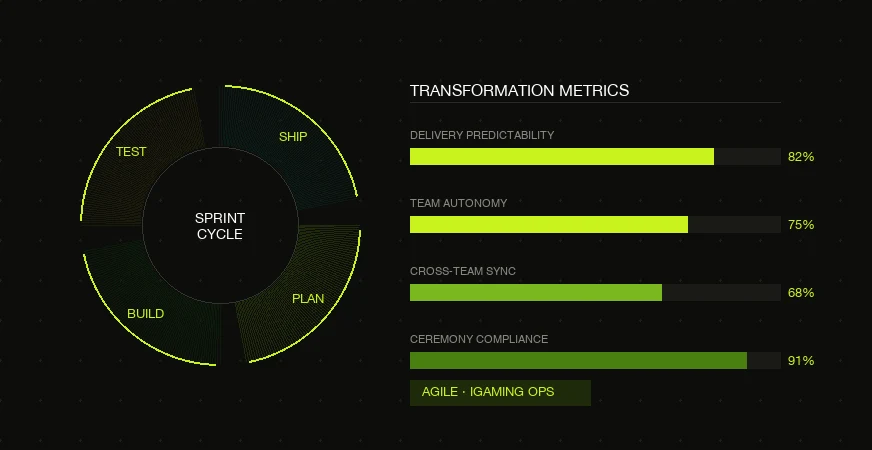
/ Comments: 0 Sergii led the Agile transformation at Playson across 12 cross-functional teams and 5 departments over nearly three years. The outcome was genuine process change — not a ceremony adoption. The distinction matters because most iGaming studios that attempt Agile transformation end up with standups and retrospectives but no improvement in delivery predictability or team autonomy.
The pattern Sergii observed consistently: Agile fails in iGaming when it's treated as a project management framework rather than an operational philosophy. Studios adopt Scrum ceremonies but keep waterfall decision-making. Sprints are planned top-down. Engineers don't own their estimates. QA is still external to the team. The rituals are there; the principles are not.

The studios that made real Agile progress all had one thing in common: leadership that changed its own decision-making process, not just the team's.
Sergii Khlivnenko The interventions that actually move metrics: giving teams real ownership of their sprint commitment, integrating QA within the development team rather than as a gate, creating complexity-adjusted velocity tracking that leadership can trust, and — critically — coaching leadership to make decisions based on team data rather than gut feeling. This is slower to implement than a new tool, and it produces results that last.
Agile isn't a ceremony. It's a different relationship between decisions and data.
- Ceremony adoption without principle change produces no delivery improvement
- QA integration within teams eliminates the most common late-stage bottleneck
- Leadership coaching is the highest-leverage intervention in any transformation
The pattern Sergii observed consistently: Agile fails in iGaming when it's treated as a project management framework rather than an operational philosophy. Studios adopt Scrum ceremonies but keep waterfall decision-making. Sprints are planned top-down. Engineers don't own their estimates. QA is still external to the team. The rituals are there; the principles are not.
Posted in : Agile iGaming